




Choice, Dignity and Belonging: Why Raven Chooses a Community Supermarket Instead of Food Bank Vouchers
11 June 2026


81% of members say that using the Pantry allows them to afford the basic essentials, 45% are able to buy healthier food and 60% were able to pay off debt/stop getting into debt.
Like many housing associations, Raven has seen a significant increase in demand for food support in recent years. First Covid, then the cost-of-living crisis, and now what feels like a new normal where many households simply cannot make their income stretch far enough.
We were seeing growing demand for food bank vouchers from our customers. We responded by strengthening our financial inclusion services and working closely with local food banks. But I increasingly found myself asking whether we were providing support in the best way possible.
Towards the end of 2023, I spent some time at a local food bank where one of our teams was providing benefits advice. I listened to conversations between volunteers and customers. People were asking whether they could swap items in their food parcels because they could not use them or because their children would not eat them. Often, they couldn't.
Outside, the queue stretched around the front of the church and onto a busy high street. People waited in full view of neighbours and passers-by.
What stayed with me wasn't the food itself, but the experience. How would I feel standing in that queue? How would I feel if someone I knew walked past? How would I feed my own family of fussy eaters from a parcel containing food I hadn't chosen? The experience left me questioning whether our response to food poverty gave enough consideration to choice and dignity.
Around the same time, I became aware of the work of Good Company, a local charity with a bold ambition: to make food banks unnecessary. Rather than simply providing emergency food, they were working with people with lived experience of poverty to design alternative solutions.
In 2023, they opened Epsom Pantry, a community supermarket, which uses the ‘Your Local Pantry’ template. I visited shortly after it opened and was immediately struck by how different it felt. It gave users the ability to choose food their families eat, to access support without feeling exposed and the ability to contribute even, through a modest membership fee.
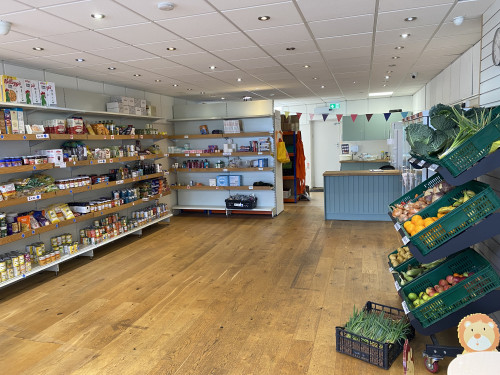
Pictured: Banstead Food Pantry
The small exchange of money helps move the experience away from charity and towards participation. It creates a different relationship between the service and the customer.
Having seen the impact of the Epsom Pantry, I was keen to explore whether we could bring the model to one of Raven's neighbourhoods. We had strong relationships with both Good Company and Reigate & Banstead Borough Council. Together, we identified Banstead as the right location and jointly funded a new Pantry which opened in Autumn 2024, run by Good Company.
At first glance, Banstead might seem an unlikely place for a community supermarket. It sits in one of the more affluent parts of Surrey, with Waitrose at one end of the high street and Marks & Spencer at the other. But as housing professionals, we know that poverty is often hidden.
If you walked into Banstead Pantry without knowing what it was, you could easily mistake it for a small grocery store.
The model is simple. Members pay £7 per visit and can choose food and household essentials worth significantly more, typically saving £40–£45 a week. Fresh fruit and vegetables sit alongside cupboard staples, fresh meat, frozen food and household products.
Most importantly, customers choose what they take home. That may sound like a small thing, but it fundamentally changes the experience. Many Pantry members are working people who would never see themselves as the "typical" food bank user. The community supermarket model helps us reach those households in a way that feels supportive rather than stigmatising.
Community supermarkets recognise that poverty is not simply about a lack of money. It is also about a loss of choice, control and confidence. By restoring some of those things, we can create support that feels empowering rather than transactional.
At Raven, the Banstead Pantry is more than a food project. It is an example of what can happen when housing associations, local authorities and community partners work together to tackle poverty differently.
In the 18 months Banstead Pantry has been open, members have saved over £225,000 in food shop costs. 81% of members say that using the Pantry has allowed them to afford the basic essentials, 45% said that they are able to buy healthier food and 60% were able to pay off debt/stop getting into debt.
At a time when demand for support continues to rise, I believe our sector needs to think beyond emergency food provision alone. We need to consider how people experience support, and whether we are creating services that preserve dignity as well as meet need.
Because ultimately, tackling poverty isn't just about helping people access food. It's about ensuring they can do so with choice, dignity and a sense of belonging.